
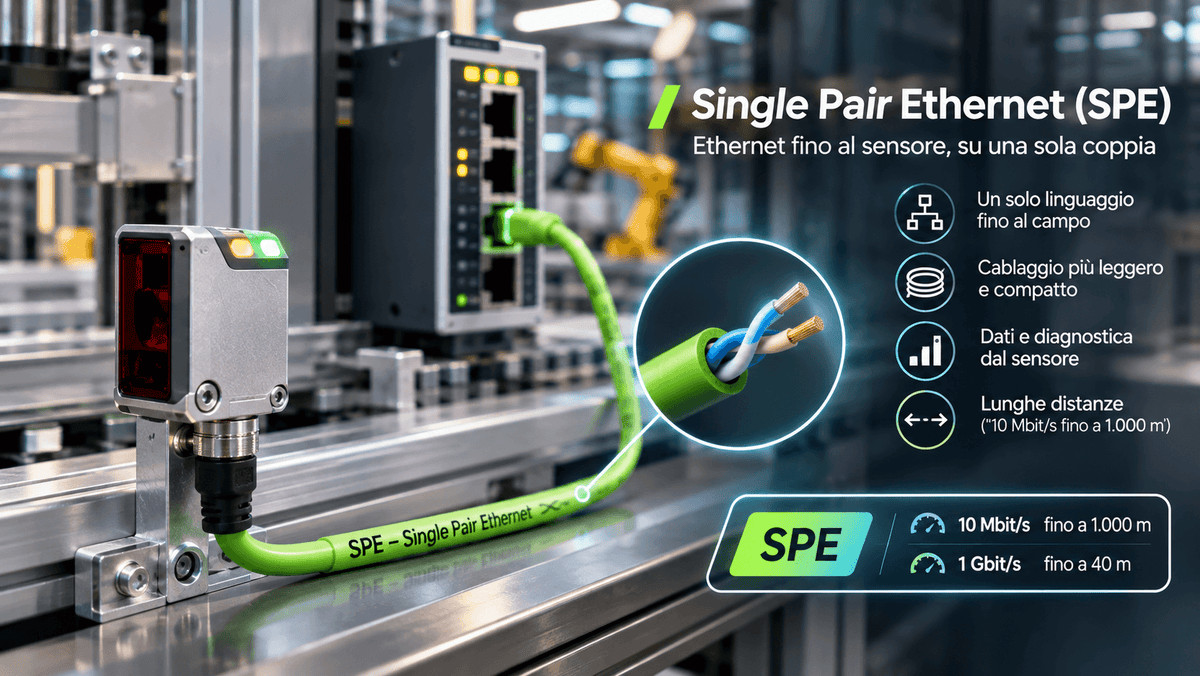
From November 24 to 26, 2026, Nuremberg will host SPS – Smart Production Solutions, the automation trade show organized by Mesago Messe Frankfurt. For those who design or maintain machines, it is a useful opportunity to discuss the evolution of field connectivity with manufacturers. One of the technical topics to know before attending is Single Pair Ethernet (SPE): a family of technologies that brings Ethernet to a single pair of conductors, down to the sensor and actuator level.
What is Single Pair Ethernet
"Classic" industrial Ethernet uses two or four pairs of conductors and 4- or 8-pin RJ45 or M12 connectors. Single Pair Ethernet uses a single twisted pair to transmit data and, in the planned variants, also to power the device. The goal is to enable the use of TCP/IP-based protocols, such as PROFINET and EtherNet/IP, even in parts of the machine where fieldbuses, analog signals, or point-to-point connections have been used until now.
Single Pair Ethernet is not a single standard, but a coordinated set of standards for transmission, cables, connectors, and wiring:
- IEEE 802.3: defines the transmission method and physical interfaces.
- IEC 61156-x: concerns balanced copper data cables.
- IEC 63171-x: concerns connectors. Part 6, published in 2020, defines the "T1 Industrial" family, covering versions from protection rating IP20 to IP65/67, including the hybrid M8 connector. Part 7 defines the mating interface also used for PROFINET over SPE.
- ISO/IEC 11801-3 and IEC 61918 / IEC 61784-5: concern universal wiring and industrial networks.
Speed and distances
The most interesting feature for automation is the compromise between speed and length. According to information published by the SPE Industrial Partner Network and manufacturers, it ranges from 10 Mbit/s over distances of up to 1,000 m to 1 Gbit/s over distances of up to 40 m.
- 10BASE-T1L (IEEE 802.3cg, approved in November 2019): 10 Mbit/s over long distances. It is the basis of Ethernet-APL, the variant designed for process automation and hazardous areas.
- 10BASE-T1S: 10 Mbit/s over short segments with multiple devices on the same cable (multidrop). Sources indicate a minimum requirement of 25 m of unshielded cable with at least 8 devices.
- 100 Mbit/s and 1 Gbit/s variants: designed for short segments, with 1 Gbit/s initially limited to 40 m.
For power supply, PoDL (Power over Data Line, IEEE 802.3bu) is used, which brings power over the same data pair. Power classes and suitable connectors are still being worked on by standardization groups (PI, ODVA, OPC Foundation, FieldComm Group): therefore, it is always advisable to check the data sheet of the individual devices.
Why it matters to those who design and maintain machines
According to manufacturers, the main advantages are:
- A single language down to the sensor: reduces the number of gateways and conversions between fieldbuses and Ethernet.
- Lighter and more compact wiring: an example published by Weidmüller indicates that PCB connectors have a footprint up to 33% smaller than RJ45. This is a figure declared by a manufacturer, referring to its products.
- Data from the field: sensors, meters, and simple devices can become network nodes with remote diagnostics and parameterization.
- Long distances with a single cable: useful in extensive plants, where previously multiple separate lines were needed for signal and power.
SPE and IO-Link: they are not direct alternatives
A common question is whether Single Pair Ethernet will replace IO-Link. The two technologies have different roles. IO-Link is a standardized point-to-point connection between a master and a single device, already widespread and with a large ecosystem of sensors and actuators. SPE is a full-fledged Ethernet network, with IP addressing and direct access from the IT level. In practice, they are likely to coexist: the choice depends on the type of device, the distance, the amount of data, and the existing infrastructure.
What to check before adopting SPE
- Connector standard: check the implemented part of the IEC 63171 standard and the required protection rating.
- Cable: category, shielding, fixed or flexible installation, diameter, and suitability for the environment (oils, cable carriers, temperatures).
- Power supply: presence of PoDL, power class, and actual power required by the device.
- Protocol and profile: compatibility with PLCs, switches, engineering tools, and used network profiles.
- Infrastructure: switches or media converters to connect SPE segments to the existing Ethernet network.
- Retrofit: in existing machines, M12 and M8 cables and circular connectors often coexist: the transition must be planned without stopping production.
Where to find connectivity components on ELEXONIK
Whether designing a new machine or working on an existing plant, the quality of the physical connection remains crucial. The ELEXONIK catalog offers automation connectors, industrial circular connectors, Ethernet cables, and cables for sensors and actuators. For collecting data from the field, IoT gateways can also be useful. If you need to replace a cable or connector on a machine already in service, contact ELEXONIK indicating the brand, code, and application.